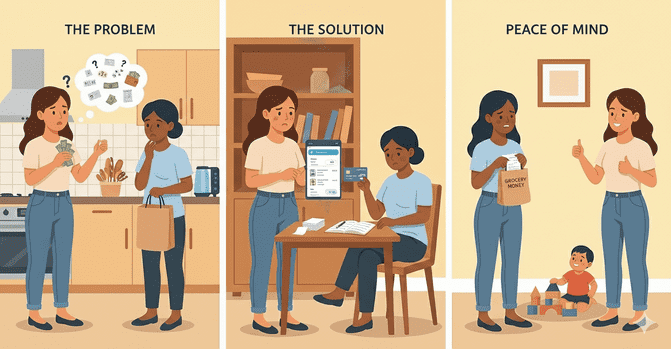
Grocery Money & Petty Cash: How to Manage Household Spending With Your Maid in Dubai
It starts small. You hand your helper 100 Dirhams to run to the corner store for milk and bread. She brings back the items, puts the change on the counter, and everyone is happy.
But as she settles into your home, the responsibilities grow. Suddenly, she is doing the weekly shop at Carrefour, ordering emergency diapers from Instashop, and paying the window cleaner. The 100 Dirhams becomes 1,000 Dirhams a month.
Without a clear system, this is where tension creeps in. You might find yourself wondering, "Did that chicken really cost 50 Dirhams?" or "Where is the receipt for the laundry?"
Managing household money isn't just about preventing theft; it is about preventing misunderstanding. If you don't have a clear process, you are setting both yourself and your helper up for failure.
Here is how smart UAE families handle grocery money and petty cash without the awkwardness.
1. The Golden Rule: Protect Both Sides
Many employers feel awkward asking for receipts because they think it signals distrust. You need to flip this mindset.
Tell your maid: "We keep receipts to protect you. If I forget how much I gave you, the notebook proves you spent it correctly."
When you frame it as protection rather than policing, it removes the shame. If you are currently in the process of hiring a maid in the UAE, mention this system during the interview so she knows what to expect from day one.
2. The "Notebook & Pouch" Method (Old School but Effective)
If you prefer using cash, you must be disciplined. Do not just hand over notes from your wallet.
The Setup:
Buy a dedicated zipped pouch and a small notebook.
Put a fixed amount (e.g., AED 500) in the pouch at the start of the month.
The Rule: Every time she takes money out, she must put a receipt in.
On the notebook page, she writes the date, the item, and the amount.
The Review: Once a week (perhaps on Friday mornings), take 5 minutes to check the pouch. If there is AED 200 left in cash, the receipts should total AED 300.
If the math is off by a few dirhams, let it slide—people make mistakes. But if there is a consistent gap, you need to address it immediately. Avoiding these small confrontations is how you prevent bigger issues later. If you are unsure how to have difficult conversations, check our guide on how to train your maid or nanny to follow your home routine, which covers communication styles.
3. The Modern Solution: Supplementary Cards
Cash is messy. It gets lost, coins roll under the sofa, and receipts fade.
Many UAE banks (like ENBD, ADCB, or digital banks like Liv and YAP) allow you to issue a Supplementary Debit/Prepaid Card linked to your account, but with a strict limit.
Why this works:
Control: You can set a limit of AED 500. She literally cannot spend more than that.
Tracking: You get an SMS notification instantly when she buys something. "AED 150 at Spinneys." You know exactly where she is and what she spent.
No Receipts Needed: The bank app acts as your logbook.
This is highly recommended for families who are busy and struggling with work-life balance in Dubai. It automates the tracking so you don't have to think about it.
4. Use the Apps (Kibsons, Noon, Amazon)
Another way to remove cash from the equation is to control the ordering yourself.
Teach your maid to use the "Cart" function.
She adds all the needed items to the cart on your phone or iPad (Kibsons for fresh food, Amazon for cleaning supplies).
She tells you when it is ready.
You review the cart for approval and press "Checkout" using your saved card.
This gives her the autonomy to choose what is needed for the house without giving her direct access to your money. It is a great middle ground.
5. What If You Suspect Dishonesty?
This is the nightmare scenario. You gave her AED 200, she came back with no receipt and only AED 50 change, and the items don't look like they cost AED 150.
Step 1: Don't Panic. Do not accuse her of "stealing" immediately. It could be a mistake, or she might have bought something for herself, thinking "it's just 10 dirhams."
Step 2: Ask for Clarification. Calmly say, "I'm looking at the change, and it seems low. Can you help me remember what else we bought?" Watch her reaction. If she gets defensive or flustered, take note.
Step 3: Reinforce the Boundary. If it happens once, give a warning. "Please remember, I need receipts for everything. I cannot give more cash until the receipts match."
If it continues, you have a trust issue. In the UAE, theft is a serious offense. However, for small amounts, it is usually grounds for termination rather than police involvement. If you are worried, read our detailed guide on what to do if you suspect your maid is stealing to handle this legally and safely.
A Note on Legal Rights: Always remember that retaining a domestic worker's passport as "security" against theft is illegal in the UAE. You must rely on trust and proper management, not coercion. You can read more about the rights and duties of domestic workers on the official UAE Government Portal.
6. Tipping and "Keep the Change."
Sometimes, lines get blurred because employers are generous. If you frequently say "Keep the change" when she goes to buy milk, she might start assuming she can keep the change every time.
Be clear.
Groceries: "Please put the change in the pouch."
Tips: "Here is AED 50 extra for you as a thank you."
Separating "work money" from "gift money" is crucial. If you are unsure about what is appropriate, we have broken down the norms in our article on how much should you tip your maid or nanny in the UAE.
7. The "Emergency Fund"
Finally, what happens if you are at work and the AC breaks, or she needs to pay a taxi urgently?
It is smart to keep a sealed "Emergency Envelope" with AED 200 in the house. Tell her: "This is only for emergencies. If you use it, call me first." This prevents her from using her own salary to fix your house problems, which she should never have to do. We discuss this kind of fairness in salary ranges for nannies in Dubai—respecting her income means not expecting her to float expenses for you.
Summary
Money does not have to be a taboo topic. By setting up a system—whether it is a high-tech bank card or a simple notebook—you are actually showing your maid respect. You are telling her, "I value clarity, and I want us to trust each other."
Start the system today. Buy the notebook, download the app, or order the card. A little organization now saves a lot of headaches later.
Disclaimer: This guide is for informational purposes only and does not constitute legal advice. For official regulations, always refer to the UAE Ministry of Human Resources & Emiratisation (MOHRE) or the official UAE government portal.
Are you looking for a Maid or Nanny in UAE?
Book your trusted help today through Peekaboo Nannies' extensive database!
Search Now